Emergency Hotline: 855-767-2482

2026 Wastewater Annual Report
GUC’s wastewater system includes two major components: the collection system and the treatment process. Our highly-trained, state-certified staff does an excellent job with both. Wastewater collection/treatment is a 24-hour-a-day, 7-day-a-week responsibility. Ultimately, our goal is to protect both the environment and the quality of life not only for the Greenville region, but for our neighboring communities as well. Each city and town along the Tar-Pamlico River Basin is affected by the quality of water discharged from the respective wastewater treatment plants to provide an annual report to their customers.
The Clean Water Act of 1999, passed by the NC General Assembly, requires wastewater systems to provide an annual report to their customers. This report summarizes the performance of our Wastewater Collection System and Wastewater Treatment Plant (WWTP) during the 12-month period from July 1, 2025 to June 30, 2026.
During this period, we collected, transported, and treated an average of 10.31 million gallons of wastewater per day (mgd) - a total of more than 3.76 billion gallons. We are proud of our collection/ treatment system and the job we do in protecting the public health and environment, meeting regulatory requirements, and accommodating the orderly growth of the region. The Clean Water Act of 1999, passed by the NC General Assembly, requires wastewater systems
2025-2026 Wastewater Report
During the past 12 months, the total estimated volume from all recorded overflows was 5,962 gallons or approximately 0.000150% percent of the total volume of wastewater that was collected, transported, and treated. There was a total of eight overflows on our wastewater collection system. Two of these overflows were due to grease, one was due to pipe failure, and the remaining were weather or other causes. Four of these overflows reached surface waters and were reported in accordance with State regulations to the NC Division of Water Resources (DWR). A Notice of Violation was issued by DEQ for each of these events. There was one penalty assessed for a spill on MacGregor Downs Road in January 2026 due to grease when approximately 1,520 gallons of wastewater reached Schoolhouse Branch.
The WWTP continued to remain compliant for all permit requirements for the past 12 months. The average percent removal for conventional pollutants remained very high at 99.7% for oxygen-demanding pollutants and 99.6% for total suspended solids. Nutrient removal rates were also very good at 76.9% for total phosphorus and 83.1% for total nitrogen. There were no Notices of Violation issued to the WWTP by regulatory agencies during the past 12 months.
KEEPING YOU INFORMED: The NC General Assembly enacted legislation in 1999 requiring municipalities, animal operations, industries, and others who operate waste handling systems to issue news releases when a waste spill of 1,000 gallons or more reaches surface waters. A waste spill of 15,000 gallons or more requires a news release as well as a paid public notice.
The network of pipes that constitutes the wastewater collection system includes more than 450 miles of gravity pipeline and 99 miles of pressure pipeline ranging in size from 4” to 48” in diameter. The gravity pipelines receive flow from more than 34,280 connections and transport it to one of 45 pump stations. The wastewater is then pumped via the pump stations and pressure pipelines to the WWTP where it is treated prior to being returned to the Tar River. This network of pipelines and pump stations collects and transports more than 11 million gallons of wastewater every day from homes and businesses in Greenville and parts of Pitt County.
Our wastewater collection system is operated and maintained under a system-wide Wastewater Collection System Permit (#WQCS00014) issued by the State of North Carolina Division of Water Resources. Construction of the system is accomplished through individual non-discharge permits issued by the State for each new extension.
We’d like to reduce system overflows to 0% so we work hard to protect our system. The following is an overview of the ways we try to protect our system and prevent overflows:
I/I Investigations
Infiltration/Inflow (I/I) is extraneous water that gets into the wastewater collection system—any water other than sewage. We have an extensive program that includes smoke testing, closed-circuit TV inspection, and flow monitoring to assist us in identifying areas of extraneous flow. Once we have located problem areas, we take steps to remediate the problem. During the past year, our TV crews inspected an average of more than 10,271 linear feet of sewer main each month.
Fats, Oils and Grease (FOG) Program
Residual fats, oils, and grease are a by-product of food service establishments. Commercial customers that serve food or process meat, etc. are required to have grease interceptors. These grease removal devices are designed to remove animal fats and vegetable oils, leading causes of sewer line blockages. Commercial customers that service or wash motorized vehicles are also required to have sand/oil interceptors. These devices help protect the wastewater collection system by removing sediments, oil, grease, and light petroleum products from the wastewater discharge. Staff inspected more than 320 grease interceptors last year.
Routine Pipe Cleaning
Each month, we routinely cleaned an average of more than 21,347 linear feet of sewer pipe with special high-pressure equipment designed to remove grease and other debris from the system and inspected 1,603 manholes. This routine cleaning and inspection program further reduces the potential for system blockages and overflows.
Priority Cleaning
Portions of the wastewater collection system are more problematic than others and require more frequent cleaning. These portions of the system are cleaned a minimum of once annually to prevent blockages and/or overflows.
Education
We have an active educational campaign involving fliers, door hangers, newsletters, and advertising designed to inform the public on ways they can help us protect the sanitary sewer system. This year, that also included reaching out to large rental facilities to help educate tenants. Each year, we welcome hundreds of students who visit and tour the Wastewater Treatment Plant as part of their education. Our state-of-the-art treatment system offers a unique opportunity for young people to see how biological science applies to the real world. We have also hosted tours for individuals from the community who have an interest in seeing how the plant operates. For further information, or to schedule a tour, please call (252) 551-3304.
Wastewater treatment is the biological process of removing pollutants from the water so it can be returned safely to the environment. It is the “last line of defense” against water pollution. GUC’s WWTP protects the environment from water that may contain disease-causing bacteria or other pollutants.
Our WWTP was built in 1985 with a capacity to treat 10.5 mgd. In 1995, the plant was expanded and upgraded to treat a capacity of 17.5 mgd. The upgrade included a state-of-the-art sustainable treatment technology known as biological nutrient removal. The complex nutrient removal system has since been optimized and now produces some of the highest quality reclaimed water in the industry.
The WWTP discharges treated effluent into the Tar River, which is permitted by the State of North Carolina under its National Pollutant Discharge Elimination System program. The discharged effluent adheres to the target limits for total nitrogen and total phosphorus as part of our membership in the Tar-Pamlico Basin Association (TPBA).
The WWTP operates under a permit issued by the State of North Carolina, Department of Environmental Quality, Division of Water Resources. The National Pollutant Discharge Elimination Permit (#NC 0023931) allows Greenville Utilities to discharge treated water back into the Tar River. For many of the tested pollutants, the water returned to the Tar River is much cleaner than when withdrawn for use.

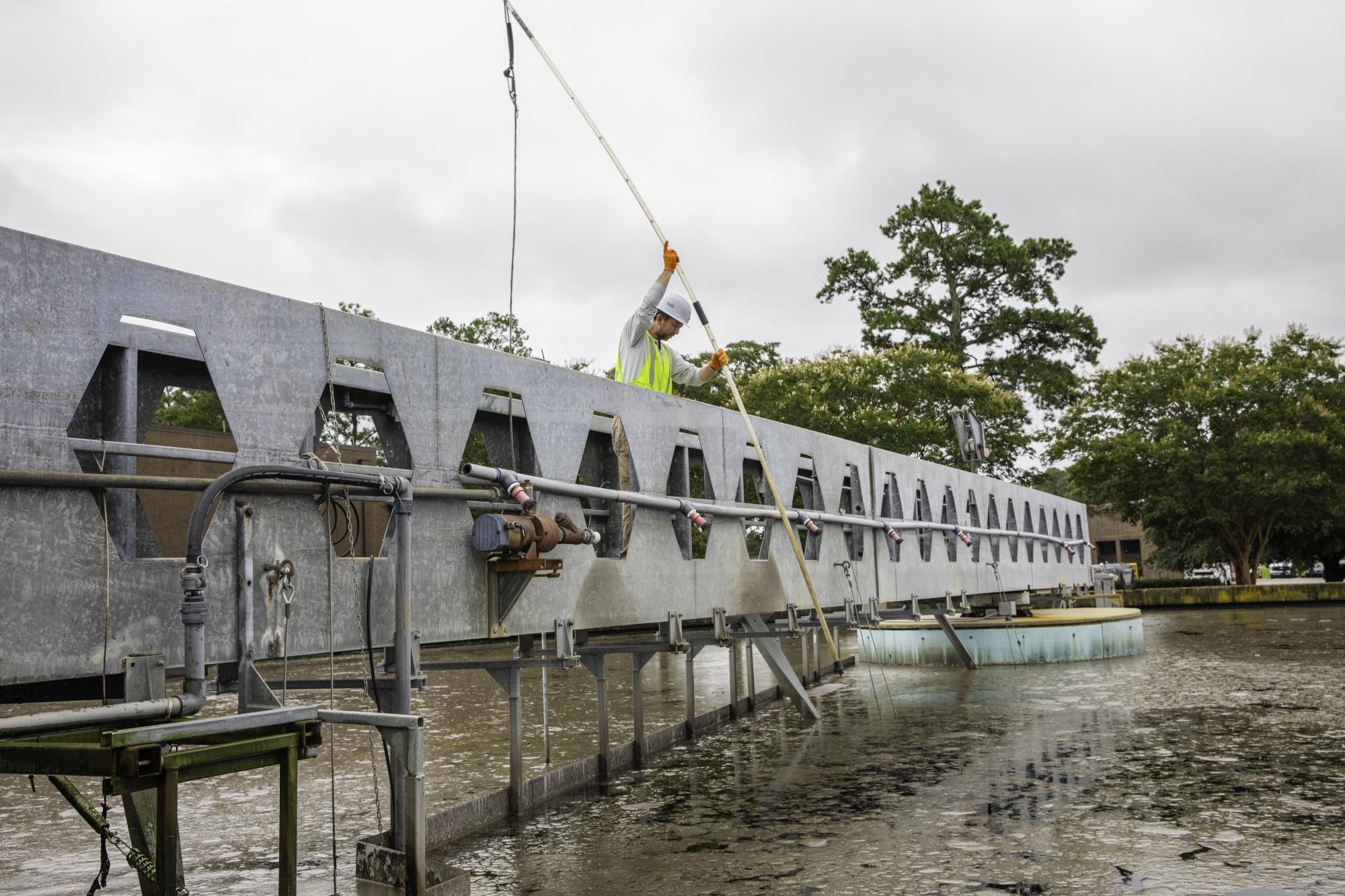
Treatment is accomplished through a three-stage process: Primary, Secondary and Tertiary.
Primary Treatment
1. Water passes through screens to remove plastics, wood, and other floating objects, as well as sand, grit, and other heavy solids.
Secondary Treatment
2. To remove any remaining solid materials in the water, compressed air (O2) is supplied in an aeration tank to stimulate growth of helpful microorganisms, which consume organic matter in the wastewater.
3. The nutrient removal process uses bacteria to remove nutrients (like nitrogen and phosphorus) that are harmful to aquatic life.
4. A secondary clarification tank allows the microorganisms and solid wastes to form clumps and settle to the bottom. Some of this residue is mixed with air again and reused in the aeration tank. The remaining residue is used in our beneficial reuse/recycle program. Biological residue (biosolids) from the treatment process is handled by our Dewatering Facility. The dewatered biosolids are mixed with organic fillers and processed to produce compost. A private compost firm turns our treatment plant process residue into environmentally-friendly, reusable material.
Tertiary Treatment
5. The water then passes through a deep-bed sand filter before it is disinfected.
6. Next, the water passes through an ultraviolet disinfection system in which the light inactivates bacteria in the water so it cannot reproduce.
7. The filtered and disinfected water is then returned to the aquatic environment of the Tar River.
Annual Sewer Improvements
Each year, Greenville Utilities funds the annual sewer improvements specifically aimed at reducing inflow and infiltration or replacing infrastructure that is near failure. This year’s improvements included lining 26 manholes to restore the interior surfaces and then sealing those manholes to reduce inflow and infiltration.
WWTP Clarifier Improvements
GUC’s secondary treatment capacity had been reduced due to failure of clarifier #1 located on the North Plant side of the WWTP. The project included the construction of two new 125-foot diameter secondary clarifiers at the South Plant to restore existing capacity. This project was completed in October of 2025.
Bethel Wastewater System Improvements
This project included construction of a new Bethel North Pump Station and Bethel Main Pump Station as well as various point repairs to gravity mains and manholes throughout the system. These improvements provide a system that meets GUC’s standards and provides conformity with the GUC system. This project has been completed.
Southeast Area Sewer Extensions
This project built a pumpstation and sewer infrastructure to provide sewer service to approximately 525 acres in the southeast area of our service area. This is near Hollywood Crossroads, DH Conley High School, and Hope Middle School. This project has been completed.
Essentially, a wastewater collection system is like a transportation highway. A series of pumps and pipes transports wastewater from our customers to the Wastewater Treatment Plant. We must do all we can to make sure “traffic” isn’t allowed to back up. On the highway it would be called a traffic jam. In our case, when “traffic” backs up, it’s called an overflow. Overflows are bad for the environment and can result in stiff penalties from state regulators.
Most overflows occur when a blockage prevents the normal flow of wastewater. This causes a build-up in the pipe that can eventually spill out of the top of a manhole or clean-out. Historically, the majority of overflows on our system are caused by blockages, which often occur as a result of improper disposal of grease, flushable wipes, and other debris. Some overflows are caused by excessive inflow and infiltration or leaks into the sewer system. In addition, some problems are caused by tree roots, pipe failure, or pipes damaged by private utilities contractors.
Grease is a real “pain in the drain” because it can clog sewer lines, which can lead to sewer spills. GUC does everything it can to prevent sewer spills, but we can’t do it alone. We need your help!
The best way you can “cease the grease” is to never pour grease (things like oil, butter, margarine, shortening, pan drippings, and sauces) down the drain. Instead, let it cool down, collect it in a container—like a used soup can or mayonnaise jar—and throw it away in the trash.
And don’t believe your friends who say (1) it’s okay to pour grease down the drain as long as you run the water at the same time, or (2) it’s perfectly fine to dump grease if you use your garbage disposal to break it up. These are myths. It’s never okay to pour any type of grease down the drain.
Here are some more ways to help prevent sewer spills:
Wipe or scrape your dishes before washing them.
Remove excess oil from pots and pans with a paper towel and throw away the towel in a trash can.
Use strainers in sink drains to collect food scraps and throw away the scraps in the trash.
Thanks for your help, and please spread the word about how important it is to “cease the grease.” Together, we can protect our sewer system and the environment. For more information, call (252) 551-1551.
Mercury is a natural element and has been used in many products and applications. However, if handled improperly, small amounts of are harmful to humans and wildlife.
- Household sources
- Thermometers
- Old Thermostats
- Fluorescent lights
- Oil based paints
- Batteries
- Barometers
Do not dispose of mercury containing products into your drains or into the trash.
Where To Recycle
Pitt Country Recycling Center
3025 Landfill Rd, Greenville, NC 27834
(252) 902-3350
More information:
Human waste and toilet paper should be the only things going down the toilet. Unfortunately, over the years, some people have turned the toilet into a trash can; from medications and sanitary products to deceased pet fish and cigarette butts, if it fits, people flush it.
Flushing these types of items down the toilet unnecessarily wastes water (up to five gallons of water with every flush), causes blockages in home plumbing and the public wastewater system, and most importantly can result in huge impacts on our sewer system, the environment, and the water we strive to protect.
All of these items are made of materials that don’t break down and can cause blockages and overflows. The trash is the proper place for the disposal of these items. Here is a list of items that people commonly flush that should NOT go down the toilet:
Sanitary Products
Paper Towels
Diapers
Baby Wipes
Facial Tissues
Condoms
Dental Floss
Prescription/Over-the-Counter Medications
For more information about what you can do to protect the wastewater system and the environment call, (252) 551-1551.